



Forza Horizon 6 Platform & Handling Tuning Guide
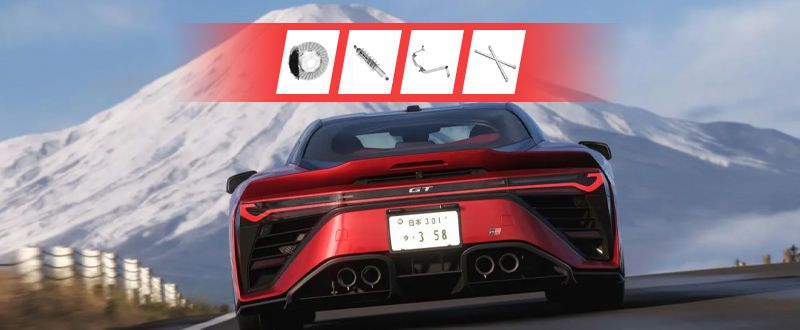
Forza Horizon 6 tuning is as deep as it is rewarding, and the Platform & Handling category is where most of that depth lives. This is the suspension and chassis side of your build - springs, dampers, anti-roll bars, brakes, weight reduction, and chassis reinforcement. The choices you make here determine how the car responds to your inputs, how it handles weight transfer through corners, and how predictable it feels at the limit.
This guide covers every Platform & Handling decision you'll face in FH6: springs and dampers, anti-roll bars, brakes, weight reduction, and chassis reinforcement, plus the full tuning methodology for the sliders these upgrades unlock - alignment (camber, toe, caster), spring rates, ride height, damping (bump and rebound), ARB stiffness, and brake balance.
The Springs & Dampers upgrade is one of the most important choices in the Platform & Handling category because it unlocks the largest set of tuning sliders in the entire game. Without an upgraded suspension, your alignment, spring, damping, and ride height settings are all locked at factory values.
Springs and Dampers tiers in FH6:
The biggest decision in this category: whether to spend the PI on Race (or Rally / Off-Road) tier suspension. Race suspension costs 2-5 PI depending on the car, and isn't always worth it if you can't put the unlocked tuning to use. At B class and below, the factory geometry is often acceptable and the PI is better spent on tires or power. At A class and above, full suspension tuning becomes essential for competitive lap times.
Anti-roll bars (ARBs) connect the left and right wheels of an axle. They control how much body roll happens through corners and are the primary tool for mid-corner balance. Stiffening an ARB reduces grip on that axle (less compliance) and transfers weight to the opposite axle.
ARB tiers in FH6:
ARB stiffness logic:
Drivetrain-specific ARB targets:
These are starting points. Adjust based on driving feel. If the car understeers, soften the front; don't stiffen the rear.
Brake upgrades affect both stopping distance and weight, and the Race tier unlocks brake balance and pressure tuning in the Tune menu.
Brake tiers in FH6:
Tuning Brake Balance (Race Brakes required): The Brake Balance slider controls the front-to-rear distribution of braking force. 50% means equal split between front and rear; higher means more front bias; lower means more rear bias.
Tuning Brake Pressure (Race Brakes required): Controls the maximum brake force applied when fully pressing the brake pedal. Values typically range from 70% to 200%.
Weight Reduction is a chassis-wide modification that removes interior trim, sound deadening, and structural components to reduce vehicle mass. Unlike Driveline or Clutch (covered in the Drivetrain Tuning Guide), Weight Reduction shaves the biggest chunks of weight per PI.
Weight Reduction tiers in FH6:
When to upgrade Weight Reduction:
Weight Reduction is one of the few upgrades that simultaneously improves acceleration, braking, cornering, and lateral G force. There's no situation where lower weight hurts; the only question is whether the PI cost is justified.
Chassis Reinforcement (sometimes labeled Roll Cage on certain cars) stiffens the body shell, improving handling precision at the cost of added weight. The trade-off is: more body rigidity = more direct steering response and better suspension behavior, but you're adding 10-30 kg.
Chassis Reinforcement tiers in FH6:
When to upgrade:
The Alignment section of the Tune menu unlocks once Race, Rally, or Off-Road Springs & Dampers are installed. It contains four sliders: front camber, rear camber, front toe, rear toe, and front caster.
Camber: The angle of the tire from vertical, viewed head-on. Negative camber means the tops of the tires lean inward.
Toe: The angle of the tires from straight-ahead, viewed from above. Toe-in means the tires point slightly toward each other; toe-out means they point slightly away.
Caster: The backward tilt of the front suspension pivot axis. Affects steering self-centering and dynamic camber under steering input.
Spring rate controls how stiff each axle's springs are. Spring rates are calculated based on car weight, weight distribution, and discipline.
Spring rate methodology (Linear Interpolation): Rate = ((Max Rate - Min Rate) × Slider Position %) + Min Rate. The car's specific kgf/mm range is shown in the tune menu and varies per chassis.
Slider position targets:
Weight distribution adjustment: Shift roughly 4 kgf/mm of spring rate per 1% deviation from 50/50. If the car is 60/40 front-heavy, add 40 kgf/mm to the front and subtract 40 kgf/mm from the rear (after the base calculation).
Special suspension types:
Ride Height: How high the chassis sits above the ground.
Damping controls how fast the suspension compresses and extends. Each axle has two sliders: Bump (compression) and Rebound (extension).
The damping rule: Bump = 40-70% of Rebound. Target ~60% as a baseline. This means rebound is always stiffer than bump.
Front damping calculation:
For a 1,400 kg car with 60% front weight on Sports tier: Front Bump = 4.6 + (1,400 × 2.205 × 0.60 / 200) × 0.1 = 4.6 + 0.93 = 5.5. Front Rebound = 5.5 / 0.6 = 9.2.
Rear damping offset: Determined by the front-to-rear spring rate difference.
If the front spring is stiffer than rear, the offsets are positive (front damper > rear damper). If the rear is stiffer (FWD setups), the offsets are negative.
Special suspension types:
The ARB Stiffness sliders (Front and Rear) typically range from 1.00 (very soft) to 65.00 (very stiff).
Base ARB calculation: Base = (Weight in lb / 2) / (200 - 200 × Stiffness%), where Stiffness% comes from the car class:
Then distribute Front/Rear based on weight distribution:
Example: a 1,400 kg AWD car with 60% front weight, High Performance class at 43% stiffness:
Then adjust by feel.
Different disciplines reward different chassis configurations. Here's the quick reference:
Thank you for taking the time to read our guide and we hope it provided you with helpful information! If you have any feedback or questions, or if you would like to contribute to our guides yourself, feel free to reach out to us on Discord!
This guide covers every Platform & Handling decision you'll face in FH6: springs and dampers, anti-roll bars, brakes, weight reduction, and chassis reinforcement, plus the full tuning methodology for the sliders these upgrades unlock - alignment (camber, toe, caster), spring rates, ride height, damping (bump and rebound), ARB stiffness, and brake balance.
Springs and Dampers
The Springs & Dampers upgrade is one of the most important choices in the Platform & Handling category because it unlocks the largest set of tuning sliders in the entire game. Without an upgraded suspension, your alignment, spring, damping, and ride height settings are all locked at factory values.
Springs and Dampers tiers in FH6:
- Stock Springs & Dampers - Factory suspension. No tuning sliders unlocked. The lightest, cheapest option. Acceptable on D-class and some C-class builds where the PI cost of upgrading would outweigh the benefit.
- Street Springs & Dampers - Modest upgrade. Usually unlocks the tire pressure slider but keeps alignment, springs, damping, and ride height locked. Limited tuning benefit.
- Sport Springs & Dampers - Same lock structure as Street tier in most cars - the alignment, spring rate, damping, and ride height sliders typically remain locked. Saves PI compared to Race but limits your ability to optimize the chassis.
- Race Springs & Dampers - Unlocks the full suspension tuning suite: alignment (camber, toe, caster), spring rate (front and rear), ride height (front and rear), and damping (bump and rebound, front and rear). The standard choice for any serious build at A class and above.
- Rally Springs & Dampers - Available on chassis that support off-road conversions. Unlocks the same full tuning suite as Race tier but at values calibrated for loose surfaces (higher ride heights, softer spring ranges). Use this for dirt racing builds.
- Off-Road Springs & Dampers - Maximum compliance suspension. Unlocks the same tuning suite as Race/Rally with values optimized for the most extreme terrain. Use this for cross country builds where ground clearance and impact tolerance matter most.
The biggest decision in this category: whether to spend the PI on Race (or Rally / Off-Road) tier suspension. Race suspension costs 2-5 PI depending on the car, and isn't always worth it if you can't put the unlocked tuning to use. At B class and below, the factory geometry is often acceptable and the PI is better spent on tires or power. At A class and above, full suspension tuning becomes essential for competitive lap times.
Anti-Roll Bars
Anti-roll bars (ARBs) connect the left and right wheels of an axle. They control how much body roll happens through corners and are the primary tool for mid-corner balance. Stiffening an ARB reduces grip on that axle (less compliance) and transfers weight to the opposite axle.
ARB tiers in FH6:
- Stock ARBs - Factory stiffness. No tuning slider. Acceptable on low-class builds.
- Street and Sport ARBs - In most cars, these tiers do not unlock the ARB stiffness slider. They mostly exist as small PI / weight adjustments.
- Race ARBs (Front and Rear) - Unlocks the ARB Stiffness slider for that axle, allowing values from approximately 1.00 (very soft) to 65.00 (very stiff). Front and rear can be installed independently. The standard choice for any A-class or higher build.
ARB stiffness logic:
- Stiffer front ARB - Less front grip, more understeer. Used to settle a car that snap-oversteers.
- Softer front ARB - More front grip, less understeer. Used to fight chronic understeer.
- Stiffer rear ARB - Less rear grip, more rotation (oversteer character). Used to fight AWD understeer or to make FWD rotate.
- Softer rear ARB - More rear grip, more stable rear. Used when the car feels loose under power.
Drivetrain-specific ARB targets:
- RWD - Typically Front 18-25, Rear 25-35. Stiffer rear to settle the chassis under power and reduce rear roll.
- AWD - Typically Front 22-30, Rear 28-38. Softer front (more front grip) and stiffer rear (rotation) to fight AWD's inherent understeer.
- FWD - Typically Front 8-15, Rear 25-40. Very soft front (the driven axle wants maximum grip) and stiff rear (to rotate the car through lift-off oversteer).
These are starting points. Adjust based on driving feel. If the car understeers, soften the front; don't stiffen the rear.
Brakes
Brake upgrades affect both stopping distance and weight, and the Race tier unlocks brake balance and pressure tuning in the Tune menu.
Brake tiers in FH6:
- Stock Brakes - Factory brakes. No tuning sliders. Often surprisingly competent at low classes.
- Street Brakes - Modest stopping improvement. No tuning unlock in most cars.
- Sport Brakes - Better stopping than Street, still no tuning unlock in most cars.
- Race Brakes - Maximum stopping power and unlocks Brake Balance and Brake Pressure sliders in the Tune menu. The standard choice for any A-class or higher road race build.
Tuning Brake Balance (Race Brakes required): The Brake Balance slider controls the front-to-rear distribution of braking force. 50% means equal split between front and rear; higher means more front bias; lower means more rear bias.
- RWD - 50-55% front bias. Slight front bias matches the forward weight transfer under braking.
- AWD - 52-56% front bias. Similar to RWD; AWD doesn't change braking distribution dramatically.
- FWD - 55-62% front bias. The front wheels have more weight on them and more total grip available, so more brake force can be applied there.
- Drift / Dirt - 45-50% (more rear-biased). More rear brake force helps initiate slides and lock the rear for rotation.
Tuning Brake Pressure (Race Brakes required): Controls the maximum brake force applied when fully pressing the brake pedal. Values typically range from 70% to 200%.
- 100% (default) - Balanced setting. Maximum force without excessive ABS-like lockup behavior.
- Above 100% (105-115%) - More aggressive stopping. Useful on heavy cars that struggle to slow down, but risks wheel lockup without ABS.
- Below 100% (85-95%) - Softer braking. Useful for trail-braking finesse on light cars or when running without ABS assist.
Weight Reduction
Weight Reduction is a chassis-wide modification that removes interior trim, sound deadening, and structural components to reduce vehicle mass. Unlike Driveline or Clutch (covered in the Drivetrain Tuning Guide), Weight Reduction shaves the biggest chunks of weight per PI.
Weight Reduction tiers in FH6:
- Stock Weight - Full interior, all factory weight. No PI cost.
- Street Weight Reduction - Minor stripping. Saves 20-50 kg depending on the car. Low PI cost.
- Sport Weight Reduction - Moderate stripping. Saves 50-100 kg. Moderate PI cost.
- Race Weight Reduction - Full race stripout. Saves 100-200 kg or more on luxury cars and trucks. Higher PI cost but huge gains on heavy chassis.
When to upgrade Weight Reduction:
- Always on heavy cars - Cross country trucks, luxury sedans, classic muscle cars. Race tier almost always pays for itself.
- Selectively on mid-weight cars - Sports cars and hot hatches. Sport tier is the usual sweet spot; Race is worth it if you have PI budget.
- Often skipped on already-light cars - Small kei cars (under 800 kg) get diminishing returns. The PI cost may exceed the benefit; check PWR before and after to verify.
Weight Reduction is one of the few upgrades that simultaneously improves acceleration, braking, cornering, and lateral G force. There's no situation where lower weight hurts; the only question is whether the PI cost is justified.
Chassis Reinforcement / Roll Cage
Chassis Reinforcement (sometimes labeled Roll Cage on certain cars) stiffens the body shell, improving handling precision at the cost of added weight. The trade-off is: more body rigidity = more direct steering response and better suspension behavior, but you're adding 10-30 kg.
Chassis Reinforcement tiers in FH6:
- Stock Chassis - Factory rigidity. Acceptable for most low-class builds.
- Street Reinforcement - Minor stiffening. Modest handling improvement.
- Sport Reinforcement - Moderate stiffening. Noticeable handling improvement for moderate weight gain.
- Race Reinforcement / Full Roll Cage - Maximum stiffness. Strongest handling improvement but biggest weight penalty.
When to upgrade:
- Race builds at A class and above - Usually worth it; the rigidity helps the suspension work as designed.
- Light cars (under 1,000 kg) - Be careful. The added weight from Race Reinforcement on a light chassis can hurt PWR more than the rigidity helps.
- Cross country / dirt builds - Race Reinforcement pays off here because the chassis takes constant punishment from terrain. Street Chassis often flexes too much over jumps and bumps.
- Drag builds - Skip it. You're not cornering hard enough to need the rigidity, and the weight hurts launch.
Tuning Alignment (Race or Rally Springs required)
The Alignment section of the Tune menu unlocks once Race, Rally, or Off-Road Springs & Dampers are installed. It contains four sliders: front camber, rear camber, front toe, rear toe, and front caster.
Camber: The angle of the tire from vertical, viewed head-on. Negative camber means the tops of the tires lean inward.
- Road race - asphalt - Front -1.0° to -2.0°, Rear -0.5° to -1.0°. More negative = more cornering grip but less straight-line braking and acceleration grip. Use the higher end (-2.0°) for slick tires; the lower end (-1.0°) for sport tires.
- Dirt rally - Front -0.8° to -1.2°, Rear -0.5° to -0.8°. Less aggressive than road race because dirt rewards flat contact patches over angled ones.
- Cross country - Front -0.5°, Rear -0.5°. Minimal camber. CC needs flat tires for maximum contact on loose surfaces and jump landings.
- Drift - Front -3.0° to -5.0°, Rear -1.0°. Aggressive front camber to maintain grip during high steering angles.
Toe: The angle of the tires from straight-ahead, viewed from above. Toe-in means the tires point slightly toward each other; toe-out means they point slightly away.
- Default - 0.0° both ends. Only deviate from neutral as a last resort.
- Slight front toe-out (-0.1° to -0.2°) - Sharper turn-in. Use if camber alone doesn't fix understeer.
- Slight rear toe-in (+0.1° to +0.3°) - More high-speed stability. Use if the rear feels twitchy under braking or at high speed.
- Any non-zero toe causes tire scrub - Top speed loss and tire wear. Use sparingly.
Caster: The backward tilt of the front suspension pivot axis. Affects steering self-centering and dynamic camber under steering input.
- Range: 5.0° - 7.0°
- Lighter / agile cars - 5.0° to 5.5°
- Mid-weight road race cars - 5.5° to 6.5°
- Heavier / high-speed cars - 6.5° to 7.0°
- Don't max it out - Caster above 7° causes the contact patch to switch violently between inside and outside mid-corner, ruining tire wear and predictability.
Tuning Springs and Ride Height (Race or Rally Springs required)
Spring rate controls how stiff each axle's springs are. Spring rates are calculated based on car weight, weight distribution, and discipline.
Spring rate methodology (Linear Interpolation): Rate = ((Max Rate - Min Rate) × Slider Position %) + Min Rate. The car's specific kgf/mm range is shown in the tune menu and varies per chassis.
Slider position targets:
- Sports class - Front 87-98%, Rear 58-80% (for RWD/AWD). FWD swaps these (Front 58-80%, Rear 87-98%).
- High Performance class - Front 85-93%, Rear 63-84% (for RWD/AWD). FWD swaps.
- Race Car class - Front 83-93%, Rear 59-85% (for RWD/AWD). FWD swaps.
Weight distribution adjustment: Shift roughly 4 kgf/mm of spring rate per 1% deviation from 50/50. If the car is 60/40 front-heavy, add 40 kgf/mm to the front and subtract 40 kgf/mm from the rear (after the base calculation).
Special suspension types:
- Rally Springs - Halve the Race Spring values for dirt rally builds. Softer springs absorb terrain instead of bouncing off it.
- Off-Road Springs - Even softer than Rally. Use slider positions around 39-40% front and 6-7% rear for cross country builds.
Ride Height: How high the chassis sits above the ground.
- Road race - Minimum both ends. Lowest center of gravity = best cornering. Raise only if you bottom out on curbs.
- Dirt rally - 70-80% of slider range. High enough to clear stage debris, low enough to maintain reasonable CG.
- Cross country - Maximum both ends. Ground clearance over jumps and ruts is non-negotiable.
- Drag - Minimum front, slightly higher rear (slight rake forward). Maximizes traction off the line.
- Drift - Minimum both ends.
Tuning Damping (Race or Rally Springs required)
Damping controls how fast the suspension compresses and extends. Each axle has two sliders: Bump (compression) and Rebound (extension).
The damping rule: Bump = 40-70% of Rebound. Target ~60% as a baseline. This means rebound is always stiffer than bump.
Front damping calculation:
- Front Bump = Min Bump (from car class) + (Front Weight in lb / 200) × 0.1
- Min Bump by car class - Sports 4.4-4.8, High Performance 4.5-4.9, Race Car 4.7-4.9
- Front Rebound = Front Bump / 0.6 (so bump is 60% of rebound)
For a 1,400 kg car with 60% front weight on Sports tier: Front Bump = 4.6 + (1,400 × 2.205 × 0.60 / 200) × 0.1 = 4.6 + 0.93 = 5.5. Front Rebound = 5.5 / 0.6 = 9.2.
Rear damping offset: Determined by the front-to-rear spring rate difference.
- Spring diff 0-1.5% - Rear Rebound -0.2, Rear Bump -0.1 from front values
- Spring diff 1.5-35% - Rear Rebound -0.3, Rear Bump -0.2
- Spring diff 36-40% - Rear Rebound -0.6, Rear Bump -0.4
- Spring diff above 40% - Rear Rebound -1.2, Rear Bump -0.8
If the front spring is stiffer than rear, the offsets are positive (front damper > rear damper). If the rear is stiffer (FWD setups), the offsets are negative.
Special suspension types:
- Rally / Off-Road - Add +1.0 to rebound across the board for additional terrain absorption recovery.
Tuning ARB Stiffness (Race ARBs required)
The ARB Stiffness sliders (Front and Rear) typically range from 1.00 (very soft) to 65.00 (very stiff).
Base ARB calculation: Base = (Weight in lb / 2) / (200 - 200 × Stiffness%), where Stiffness% comes from the car class:
- Sports - 61-65%
- High Performance - 40-46%
- Race Car - 35-62%
Then distribute Front/Rear based on weight distribution:
- RWD - +1 ARB per 1% weight distribution above 50% on front
- FWD - -1 ARB per 1% (which often gives a very soft front)
- AWD - 0.66 per 1% (less aggressive than RWD)
Example: a 1,400 kg AWD car with 60% front weight, High Performance class at 43% stiffness:
- Base = (1,400 × 2.205 / 2) / (200 - 200 × 0.43) = 1,544 / 114 = 13.5
- AWD distribution: +0.66 × 10 = +6.6 to front, -6.6 to rear
- Front ARB = 13.5 + 6.6 = 20.1, Rear ARB = 13.5 - 6.6 = 6.9
Then adjust by feel.
Discipline-Specific Platform Strategy
Different disciplines reward different chassis configurations. Here's the quick reference:
- Road racing - twisty circuits - Race Springs, Race ARBs, Race Brakes, Race or Sport Weight Reduction. Stiff suspension, minimum ride height, aggressive camber, neutral toe, moderate caster. Maximum mechanical grip through corners.
- Road racing - speed circuits - Same as above but soften the front spring 5-10% and slightly raise ride height to absorb high-speed bumps without losing too much grip.
- Dirt racing - Rally Springs, Race ARBs, Race Brakes, Sport or Race Weight Reduction. Softer springs, higher ride height (70-80% of range), modest camber, slight rear toe-in for stability. ARBs softer overall than road race.
- Cross country - Off-Road Springs, Race ARBs, Race Brakes, Race Weight Reduction. Maximum compliance suspension, maximum ride height, minimal camber, slight rear toe-in. Brake bias slightly more rearward (48%) for jump landings.
- Drift - Race Springs, Race ARBs (very stiff rear), Race Brakes, Sport Weight Reduction. Aggressive front camber, soft front ARB, stiff rear ARB, low ride height. Brake bias more rearward (45%) to initiate slides.
- Drag - Race Springs, Sport ARBs (minimal stiffness), Race Brakes, Race Weight Reduction. Soft suspension, slight rake forward (lower front than rear), minimal camber. The chassis isn't doing much; weight reduction matters most.
Common Platform & Handling Mistakes
- Skipping Race Springs at A class and above - Without Race or Rally Springs, your alignment, springs, damping, and ride height sliders are all locked. You're driving a car that can't be tuned. Race Springs are the single biggest tuning unlock in the game.
- Maxing ARBs stiffness on both ends - Stiff ARBs both ends = the car hops over road texture and loses grip on imperfect surfaces. Some softness is required for the tires to track the road. Better to pick 25-45 range as typical, not 60-65.
- Stiffening the wrong end to fix imbalance - If the car understeers, soften the front; don't stiffen the rear. If the car oversteers, soften the rear; don't stiffen the front. Stiffening the opposite end is a common newcomer mistake that adds new problems instead of solving the existing one.
- Maxing weight reduction without checking PWR - On already-light cars (under 800 kg), Race Weight Reduction may cost more PI than the weight savings is worth. Always check PWR before and after the upgrade.
- Aggressive camber on dirt builds - Loose surfaces reward flat contact patches. Camber above -1.0° on dirt costs grip without providing the cornering benefit it offers on asphalt.
- Default brake balance on FWD - FWD cars want noticeably more front brake bias (55-62%) than RWD or AWD. Running default 50% balance on FWD leaves stopping performance on the table.
- Ignoring caster - Caster is often left at default by new tuners because it's less intuitive than camber. But it significantly affects steering self-centering and dynamic camber under load. Always set caster based on car weight - 5.5° to 6.5° for most road race builds.
- Race Chassis Reinforcement on light cars - The weight gain (10-30 kg) on a light chassis can erase the rigidity benefit. Sport tier is usually the sweet spot for cars under 1,200 kg.
Glossary
- Spring Rate - How stiff the springs are, measured in kgf/mm or lb/in. Higher rate = stiffer = less body roll, less compliance.
- Ride Height - How high the chassis sits above the ground, measured in cm or in. Lower = better cornering CG; higher = better off-road clearance.
- Bump Damping - Resistance to the suspension compressing (when the wheel hits a bump). Higher = stiffer compression.
- Rebound Damping - Resistance to the suspension extending (after the wheel passes the bump). Higher = stiffer extension. Rebound is typically ~1.67x the bump value.
- ARB (Anti-Roll Bar) - Mechanical bar connecting left and right wheels of an axle. Controls body roll resistance. Stiffer ARB = less compliance on that axle = more grip transferred to the opposite axle.
- Camber - The angle of the tire from vertical when viewed head-on. Negative camber leans the tops of the tires inward, increasing contact patch during cornering.
- Toe - The angle of the tires from straight-ahead when viewed from above. Toe-in points the fronts of the tires together; toe-out points them apart.
- Caster - The backward tilt of the front suspension pivot axis. Higher caster adds steering self-centering and dynamic camber under load.
- Brake Balance - The front-to-rear distribution of braking force. 50% = equal split. Higher = more front bias.
- Brake Pressure - The maximum brake force applied at full pedal input. 100% = default; higher values are more aggressive but risk lockup without ABS.
- Bottoming Out - When the suspension hits its maximum compression. The wheel becomes briefly rigid, causing catastrophic grip loss. Fix by raising ride height or stiffening springs.
- Trail Braking - Continuing light brake pressure into the turn-in. Loads the front tires for sharper rotation. A skill technique that interacts with brake balance and damping settings.
Thank you for taking the time to read our guide and we hope it provided you with helpful information! If you have any feedback or questions, or if you would like to contribute to our guides yourself, feel free to reach out to us on Discord!
(Last Updated: May 20th, 2026)