



Forza Horizon 6 Drivetrain Tuning Guide
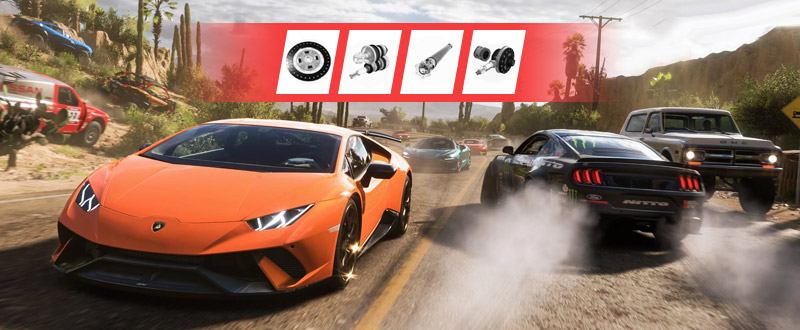
Forza Horizon 6 tuning is as deep as it is rewarding. Every car you build is a series of decisions, and the drivetrain choices you make are some of the most consequential - they shape acceleration, top speed, cornering balance, and which discipline your car is genuinely good at.
This guide covers every drivetrain decision you'll face in FH6: conversions, transmission, clutch, driveline, and differential, including the new UI changes and rebalanced part trees that arrived with FH6. We'll also walk through how each choice affects PI (Performance Index) - which now caps at A 700 and rolls into S1 at 701, after FH6's class rebalance.
Before you touch transmission, clutch, or differential, you'll decide whether to convert your car to a different drivetrain layout. FH6 offers three layouts: RWD (rear-wheel drive), FWD (front-wheel drive), and AWD (all-wheel drive). Most cars can be swapped to one or two alternatives - for example, a stock RWD sports car can often be swapped to AWD for better traction off the line and out of corners.
When to swap drivetrains:
Drivetrain swaps come with a PI cost that varies per car. Always check the PI counter before committing - an AWD swap might cost 30 PI on one car and 80 PI on another. If the swap pushes you out of your target class, consider keeping the stock drivetrain and spending that PI on chassis/engine upgrades instead.
For cars which still have their stock drivetrain (no conversion), the Street Transmission and Sport Transmission upgrades can often reduce the PI of your car, giving you the ability to afford more upgrades while remaining in your target class. This is especially true for RWD cars. It is always worth checking each tier in the upgrade menu, since the PI delta between tiers varies wildly by car.
If you have converted your drivetrain - such as swapping from RWD to AWD - your car will already be on Race Transmission as part of the conversion package.
Note: The PI cost of transmission upgrades scales depending on how much power you've added to your car, so you may want to revisit this decision after your engine upgrades.
Choosing the number of gears (Race Transmission only): FH6 offers 6, 7, 8, 9, and 10-speed options for Race Transmission. Two factors drive this decision:
If you drive Manual with Clutch (M/C), the Clutch upgrade has no effect on your shift times. Its only purpose is weight reduction. Out of all the weight reduction upgrades available, Clutch is one of the most PI-inefficient, so look at other weight-reducing upgrades first - such as Driveline or Weight Reduction - before spending PI here.
If you are not using Manual with Clutch but your car has a drivetrain conversion (e.g. RWD swapped to AWD), the above applies and you will not reduce your shift time by upgrading. The only effect is weight reduction.
If you are not using Manual with Clutch and your car is on its stock drivetrain, Clutch upgrades will speed up your shift times. Some high-performance S1/S2 cars are exceptions and shift at the same speed regardless of the upgrade. Even when Clutch does speed up shifts, it remains a PI-inefficient upgrade - competitive players almost universally drive with M/C input to remove this consideration entirely.
Recommendation: Switch to Manual with Clutch input if you haven't already. It's not just for the shift time - clutch-kick rotation, controlled wheelspin off the line, and precise downshifts all become available, and you stop needing the Clutch upgrade for shift speed entirely. Leave Clutch at Stock or Street unless you specifically need it for weight balance.
This is a popular weight reduction upgrade in FH6, and unlike Clutch, it tends to be PI-efficient. Driveline doesn't affect tuning options or unlock any sliders - it simply removes mass from the rotating drivetrain components.
Best practice: Experiment with different combinations of Driveline + other weight-changing upgrades (rims, rim size, number of gears in your transmission, flywheel, weight reduction) to find the combination that best balances PI cost against actual performance gain. On heavier cars (cross country trucks, large luxury sedans), Driveline is almost always worth upgrading to Sport or Race tier. On already-light cars (small hatchbacks, sports cars under 1,200 kg), the gain is smaller and the PI may be better spent elsewhere.
A useful FH6 trick: as you build up your car, watch the PI counter after each Driveline tier change. Sport Driveline often costs 1–3 PI and saves 10–25 kg; Race Driveline costs slightly more but trims more weight. If you're hunting for the last few PI points to stay under a class ceiling, Driveline is often where you find them.
The Differential upgrade is one of the most important - and often most misunderstood - drivetrain decisions in FH6. In FH5, Differential upgrades typically cost 0 PI, making them an obvious "always upgrade" choice. In FH6 this is still mostly true, but always check the PI counter - some cars now see a small PI bump from Race Diff that may need to be accommodated.
Differential tiers in FH6:
Discipline matching: Always pick the differential type that matches the discipline your car is built for.
For RWD cars, the Tune menu shows only the Rear section of the Differential page. For FWD cars, only the Front section. The Center Balance slider doesn't appear because there is no center differential to balance.
AWD cars in FH6 show three sections on the Differential tuning page: Front, Rear, and Center. This UI layout was updated in FH6 to make the AWD power-distribution clearer than the single-number Center value used in earlier games.
Common AWD diff starting points:
A note on Center Balance: in FH6, AWD cars often feel sluggish and understeer-prone with anything less than 65% rear bias on road race builds. Longer-wheelbase cars tolerate up to 90% rear bias; shorter wheelbases sit best around 70–80%. Always start in the 70%+ range and dial down only if the car becomes loose.
Different disciplines reward different drivetrain choices. Here's a quick reference:
Thank you for taking the time to read our guide and we hope it provided you with helpful information! If you have any feedback or questions, or if you would like to contribute to our guides yourself, feel free to reach out to us on Discord!
This guide covers every drivetrain decision you'll face in FH6: conversions, transmission, clutch, driveline, and differential, including the new UI changes and rebalanced part trees that arrived with FH6. We'll also walk through how each choice affects PI (Performance Index) - which now caps at A 700 and rolls into S1 at 701, after FH6's class rebalance.
Drivetrain Conversions
Before you touch transmission, clutch, or differential, you'll decide whether to convert your car to a different drivetrain layout. FH6 offers three layouts: RWD (rear-wheel drive), FWD (front-wheel drive), and AWD (all-wheel drive). Most cars can be swapped to one or two alternatives - for example, a stock RWD sports car can often be swapped to AWD for better traction off the line and out of corners.
When to swap drivetrains:
- AWD swap on a stock RWD/FWD car - typically chosen for road racing at S1/S2, dirt racing, or cross country. AWD adds traction at the cost of some PI and chassis character. Be aware that FH6's AWD has a slight inherent understeer bias - you'll often need to compensate with diff and ARB tuning.
- RWD swap on a stock AWD car - useful for drift builds or for preserving chassis feel at lower classes (B–A) where AWD's PI cost outweighs the traction benefit.
- Keep stock AWD - many factory AWD cars (Audi quattro, Nissan GT-R, Mitsubishi Evo, Subaru WRX/STI, BMW xDrive) come with well-tuned center differentials in FH6 and often need very little additional adjustment. If your car is one of these, leave the drivetrain alone.
Drivetrain swaps come with a PI cost that varies per car. Always check the PI counter before committing - an AWD swap might cost 30 PI on one car and 80 PI on another. If the swap pushes you out of your target class, consider keeping the stock drivetrain and spending that PI on chassis/engine upgrades instead.
Transmission
For cars which still have their stock drivetrain (no conversion), the Street Transmission and Sport Transmission upgrades can often reduce the PI of your car, giving you the ability to afford more upgrades while remaining in your target class. This is especially true for RWD cars. It is always worth checking each tier in the upgrade menu, since the PI delta between tiers varies wildly by car.
If you have converted your drivetrain - such as swapping from RWD to AWD - your car will already be on Race Transmission as part of the conversion package.
Note: The PI cost of transmission upgrades scales depending on how much power you've added to your car, so you may want to revisit this decision after your engine upgrades.
- Stock and Street Transmissions are similar in that they do not allow any tuning adjustments to the gearbox. Picking between these two is usually a question of PI cost and the actual length of the gears provided. You can usually see a difference just by looking at how your car's top speed and 0-100 km/h time change as you toggle between these two options. For most performance-oriented builds, neither will be optimal - you'll want to upgrade to Sport or Race Transmission for tunability.
- Sport Transmission is commonly the best choice if it reduces your car's PI or is significantly cheaper than Race Transmission in terms of PI. This upgrade unlocks the Final Drive slider in the Tune menu, which scales the ratios of all your gears together with a single adjustable value. Raising the Final Drive shortens every gear (better acceleration, lower top speed); lowering it lengthens every gear (worse acceleration, higher top speed). For most B-class and many A-class builds, Sport Transmission is the sweet spot - full enough tuning to dial in acceleration vs top speed without spending PI on Race tier.
- Race Transmission unlocks individual gear ratio tuning. This matters because some cars come with strange stock gearing - a very long 5th gear, a very short 3rd gear, or oddly spaced ratios that waste your engine's powerband. Race Transmission lets you smooth these out and customize the gear spacing to match your car's torque curve. The tradeoff is PI cost: Race Transmission is usually 2–8 PI more expensive than Sport, and that PI is often better spent on tires, brakes, or engine upgrades at lower classes.
Choosing the number of gears (Race Transmission only): FH6 offers 6, 7, 8, 9, and 10-speed options for Race Transmission. Two factors drive this decision:
- Weight effect on PI - Each additional gear increases your car's weight, which in turn decreases your PI slightly. Using a heavier gearbox can sometimes give you headroom to upgrade other parts. This often requires trial and error to find the best combination. Keep in mind: even if you choose the 10-speed transmission, you can effectively "delete" gears you don't need by matching their ratios to the gear above them in the Tune menu, neutralizing the gear without removing it.
- Powerband matching - Some cars perform best when held in a narrow optimal RPM window. Off-road cars using turbo engines that make peak torque at low RPMs, or race cars with V12s that want to live near redline, both benefit from more gears so you can stay in the power band as you accelerate. The tradeoff: more gears mean more shifts, and each shift costs a fraction of a second. For most road builds, 6 or 7 speeds is plenty; for drag builds or cars with extreme powerbands, 8–10 speeds may be worth it.
Clutch
If you drive Manual with Clutch (M/C), the Clutch upgrade has no effect on your shift times. Its only purpose is weight reduction. Out of all the weight reduction upgrades available, Clutch is one of the most PI-inefficient, so look at other weight-reducing upgrades first - such as Driveline or Weight Reduction - before spending PI here.
If you are not using Manual with Clutch but your car has a drivetrain conversion (e.g. RWD swapped to AWD), the above applies and you will not reduce your shift time by upgrading. The only effect is weight reduction.
If you are not using Manual with Clutch and your car is on its stock drivetrain, Clutch upgrades will speed up your shift times. Some high-performance S1/S2 cars are exceptions and shift at the same speed regardless of the upgrade. Even when Clutch does speed up shifts, it remains a PI-inefficient upgrade - competitive players almost universally drive with M/C input to remove this consideration entirely.
Recommendation: Switch to Manual with Clutch input if you haven't already. It's not just for the shift time - clutch-kick rotation, controlled wheelspin off the line, and precise downshifts all become available, and you stop needing the Clutch upgrade for shift speed entirely. Leave Clutch at Stock or Street unless you specifically need it for weight balance.
Driveline
This is a popular weight reduction upgrade in FH6, and unlike Clutch, it tends to be PI-efficient. Driveline doesn't affect tuning options or unlock any sliders - it simply removes mass from the rotating drivetrain components.
Best practice: Experiment with different combinations of Driveline + other weight-changing upgrades (rims, rim size, number of gears in your transmission, flywheel, weight reduction) to find the combination that best balances PI cost against actual performance gain. On heavier cars (cross country trucks, large luxury sedans), Driveline is almost always worth upgrading to Sport or Race tier. On already-light cars (small hatchbacks, sports cars under 1,200 kg), the gain is smaller and the PI may be better spent elsewhere.
A useful FH6 trick: as you build up your car, watch the PI counter after each Driveline tier change. Sport Driveline often costs 1–3 PI and saves 10–25 kg; Race Driveline costs slightly more but trims more weight. If you're hunting for the last few PI points to stay under a class ceiling, Driveline is often where you find them.
Differential
The Differential upgrade is one of the most important - and often most misunderstood - drivetrain decisions in FH6. In FH5, Differential upgrades typically cost 0 PI, making them an obvious "always upgrade" choice. In FH6 this is still mostly true, but always check the PI counter - some cars now see a small PI bump from Race Diff that may need to be accommodated.
Differential tiers in FH6:
- Stock Differential - No tuning sliders available.
- Sport Differential - Unlocks the Acceleration slider only. For RWD cars, this means Rear Acceleration. For FWD cars, Front Acceleration. For AWD cars, Front and Rear Acceleration sliders both unlock, but Deceleration and Center Balance remain locked.
- Race Differential - Unlocks every diff slider: Acceleration AND Deceleration on both axles, plus the AWD Center Balance slider. This is the full-tuning tier.
- Rally / Off-Road Differential - Available on some chassis. Same unlock structure as Race Differential, but the values it permits are optimized for loose surfaces. Use this for dirt racing and cross country builds.
Discipline matching: Always pick the differential type that matches the discipline your car is built for.
- Road racing, drift, drag → Race Differential
- Dirt racing → Rally Differential (if available) or Race Differential
- Cross country → Off-Road Differential (if available) or Race Differential
Differential Tuning - RWD and FWD
For RWD cars, the Tune menu shows only the Rear section of the Differential page. For FWD cars, only the Front section. The Center Balance slider doesn't appear because there is no center differential to balance.
- Acceleration - Controls how aggressively the differential locks the two driven wheels together under throttle. Higher % = wheels forced to spin at more similar speeds = more traction on power, but more understeer (RWD) or harder turn-in (FWD). For road racing, RWD Acceleration typically lives in the 40–65% range. For drift, 80–100% (near-welded behavior).
- Deceleration - Controls diff locking off-throttle and under braking. Higher % = more rear-wheel coupling on lift-off = more stability into corners. RWD road race typically sits in the 15–30% range. Too high causes lift-off understeer; too low causes lift-off oversteer.
Differential Tuning - AWD
AWD cars in FH6 show three sections on the Differential tuning page: Front, Rear, and Center. This UI layout was updated in FH6 to make the AWD power-distribution clearer than the single-number Center value used in earlier games.
- Front Acceleration / Deceleration - Controls how the front axle's diff behaves under power and off-throttle. Same logic as RWD, applied to the front wheels.
- Rear Acceleration / Deceleration - Controls the rear axle's diff under power and off-throttle.
- Center → Balance - A single slider with Front on the left and Rear on the right. The percentage shown is the percentage of torque sent to the rear axle. 50% = equal Front/Rear split. 70% = 70% of power to the rear, 30% to the front (rear-biased rally feel). 30% = 30% to the rear, 70% to the front (front-biased understeer-resistant feel).
Common AWD diff starting points:
- Road racing AWD - Front Accel 28%, Front Decel 0%, Rear Accel 100%, Rear Decel 45%, Center Balance 70–85% (rear bias). Higher Center Balance values fight AWD's inherent understeer.
- Dirt rally AWD - Front Accel 30–40%, Front Decel 0–15%, Rear Accel 55–70%, Rear Decel 20–25%, Center Balance 65–75% (slight rear bias for rotation).
- Cross country AWD - Front Accel 35–45%, Front Decel 5–15%, Rear Accel 65–75%, Rear Decel 20–25%, Center Balance 55–65% (mild rear bias for traction).
A note on Center Balance: in FH6, AWD cars often feel sluggish and understeer-prone with anything less than 65% rear bias on road race builds. Longer-wheelbase cars tolerate up to 90% rear bias; shorter wheelbases sit best around 70–80%. Always start in the 70%+ range and dial down only if the car becomes loose.
Discipline-Specific Drivetrain Strategy
Different disciplines reward different drivetrain choices. Here's a quick reference:
- Road racing (B / A class) - RWD keeps the chassis honest and rewards skill. AWD swap is only worth it at higher classes or on technical tight circuits. Race or Sport Transmission depending on PI budget; Race Differential for full tunability.
- Road racing (S1 / S2) - AWD dominates the meta. The extra grip out of corners pays for the PI cost. Race Transmission with 6–7 gears tuned to your engine; Race Differential with rear-biased Center Balance.
- Dirt racing - AWD is mandatory in the competitive meta. Race or Rally Transmission with shorter Final Drive than road race; Rally Differential if available. Rally tires are non-negotiable.
- Cross country - AWD mandatory. Race Transmission with a shorter Final Drive than dirt rally to handle technical terrain. Off-Road Differential if your car offers it.
- Drift - RWD required by the discipline. Sport or Race Transmission with longer gearing; Race Differential with maxed Acceleration (90–100%) for welded-diff drift behavior. Center Balance doesn't apply.
- Drag - AWD for launch traction. Race Transmission with 8–10 gears for staying in the powerband through the full quarter-mile; Race Differential.
Common Pitfalls and PI Optimization Tips
- Don't max every drivetrain tier by default. Race Transmission, Race Clutch, Race Driveline, and Race Differential together can eat 15–25 PI that's often better spent on tires or chassis.
- Re-check transmission PI after engine upgrades. Transmission PI cost scales with engine power. A Sport Transmission that was cheap at stock power may become a PI sink after you add Race Exhaust and Race Intake.
- Use Driveline as your PI "fine-tuner." When you're 3–8 PI over your class ceiling, Driveline tier changes often shave exactly the amount you need.
- Sport Diff is enough at B class. If you're building B600 or below, the Race Diff's extra Deceleration and Center Balance sliders are rarely worth the PI. Stick with Sport Diff and use other upgrades for chassis tuning.
- AWD swaps are not always worth it at lower classes. At B class, the PI cost of an AWD conversion can eat half your upgrade budget. Keep RWD/FWD stock unless the discipline demands AWD (dirt, CC).
- Factory AWD systems are well-tuned in FH6. Audi quattro, Nissan GT-R, Mitsubishi Evo, Subaru WRX/STI, and BMW xDrive cars come with default Center Balance values that often need only minor adjustment. Don't over-tune what's already working.
Glossary
- PI (Performance Index) - The numerical performance rating used by FH6 to classify cars. D, C, B, A, S1, S2, R. In FH6, A caps at 700 and S1 starts at 701; this is a rebalance from FH5 where A was 701–800.
- Drivetrain - The combination of engine, transmission, driveshaft, and differential that delivers power to the wheels.
- RWD / FWD / AWD - Rear-, Front-, All-Wheel Drive.
- Final Drive - The gear ratio that scales all your gear ratios together. Higher Final Drive = shorter gears = better acceleration, worse top speed.
- Differential Lock - The mechanical or electronic coupling between two driven wheels. 0% = wheels fully independent (open diff). 100% = wheels forced to spin at the same speed (welded diff).
- Center Balance - The torque split between front and rear axles on an AWD car. In FH6 displayed as a Front-to-Rear slider where the percentage represents power sent to the rear.
- M/C (Manual with Clutch) - Driving input mode that gives you full control over gearing and clutch use. Required for competitive play and unlocks the fastest shift times on most cars.
Thank you for taking the time to read our guide and we hope it provided you with helpful information! If you have any feedback or questions, or if you would like to contribute to our guides yourself, feel free to reach out to us on Discord!
(Last Updated: May 20th, 2026)